Radar Cross Section Measurements
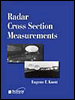
Presenting and explaining the rules of good measurement practice, this valuable reference explains how RCS is typically measured on test ranges, and how testing may be tailored to meet specific requirements.
 TABLE OF CONTENTS
 There are two kinds of indoor RCS test chamber: compact and otherwise. The compact range relies on an antenna that is so large that all test objects measured in the chamber are in the near field of the antenna. The antennas used in all other indoor chambers are much smaller, with the consequence that the far-field criterion developed in Chapter 4 is just as much a consideration in those chambers as it is outdoors. The differences in the design and operation of the two kinds of chamber are great enough that we treat them in separate chapters. We discuss all others in this chapter, reserving Chapter 8 for compact ranges.
Indoor test chambers are also called anechoic chambers literally, no echo. Despite the implication of the nomenclature, reflections from the walls of an indoor test facility are significant, and constitute the dominant sources of contamination of the target signals we seek to measure. Several methods are available to reduce the reflections and their effects, ranging from the installation of absorbers to soak up the energy, the selection of favorable chamber wall orientations, separation on the basis of time-of-arrival (range-gating), and background subtraction. We defer the discussion of the last two to Chapter 9 and discuss the others here.
The chapter is divided into four parts, the first three of which discuss applications of well-known echo-reduction methods: cancellation, shaping, and absorption. While the specific methods and materials used to achieve this suppression in the anechoic chamber are...