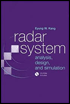
Radar System Analysis, Design and Simulation
Chapter 1 introduces matrix-vector operations. We start with how to solve a set of simultaneous linear equations by Gauss's elimination methods of the back-substitution and forward substitution that we learned in earlier years in school. When the dimension of equations is two or three we can solve for the unknowns with pencil and paper. When the dimension is higher than, say, four or higher we would rather resort to a computer program.
We encounter immediately the task of matrix inversion. Matrix inversion is usually permissible, but sometime it is not, depending upon the structure of the matrix. We learn when it is permissible by means of matrix factorization (decomposition). The factored matrices would clearly indicate whether the inversion is permissible. Several popular factorization routines and the corresponding inversions of factored matrices are programmed.
Vector operation is treated as a subset of matrix operations. Two header files, VECTOR.H and MATRIX.H, are constructed in order to determine when the matrix-vector operations are called for in the main driver.
The goal of this chapter is to generate various noises and clutters we would encounter in signal processing. The noise and clutter are characterized by the probability density function and its mean and variance. (For those who prefer electrical terms mean is DC voltage level and variance is AC power.) The basic building components of noise and clutter are unit uniform random variables, and the unit uniform variables...