Radar System Analysis, Design and Simulation
In this section we study the tracking function of an air traffic control (ATC) radar. There are two radars in the ATC system: one for a shorter range and the other for a longer range. The relevant parameters of two radars are listed below. (Later models have improved some parameters).
ATC radars detect airborne targets in range and bearing angle. No elevation angle (altitude) of the target is measured. The altitude of the target aircraft is reported to the ground control center by a transponder onboard the aircraft when interrogated by a co-located beacon radar on the ground. A counterpart in the military air control is called the identification friend or foe (IFF).
| Airport Surveillance Radar (ASR) | Air Route Surveillance Radar (ARSR) | |
|---|---|---|
| Transmitter power | 400 kW | 4 MW |
| Maximum range | 110 km (60 nm) | 370 km (200 nm) |
| Antenna gain | 34 dB | 34 dB |
| Frequency | 2.8 GHz | 1.3 GHz |
| Pulse repetition freq | 1200 pulse/sec | 360 pulse/sec |
| Antenna scan rate | 15 rev/min (90 deg/sec) | 6 rev/min (36 deg/sec) |
| Data update | 4 sec | 10 sec |
| Antenna beamwidth | 1.5 degrees | 1.35 degrees |
| ( ?3 dB azimuth)Pulsewidth | 0.8 ~ 0.9 ?sec (0.83 ?sec nominal) | 2.0 ?sec |
| Number of received pulses integrable | 20 | 13 |
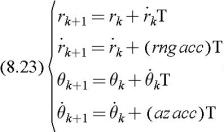
In this second example of Kalman filter processing, the state equation will be written in the LOS coordinate system. We write the state equation (aircraft's position and motion) as follows:
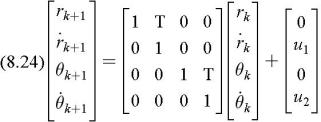
Equation (8.23) is cast into a vector-matrix form.
A...