Radar System Analysis, Design and Simulation

Chapter 11: Moving Target Indicator

11.1 Introduction

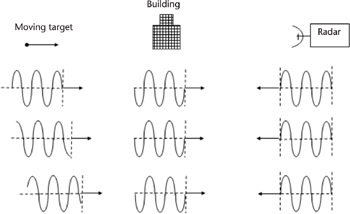
The object of moving target detection and indication is to reject returned signals from stationary objects such as buildings, hills, and islands and detect the signal from moving targets such as airborne aircrafts or maneuvering surface ships on the sea. Figure 11.1 illustrates the phase shifts of returned signals from a moving target and a constant phase from a stationary target.


Figure 11.1: Moving target causes phase shifts on returned signals

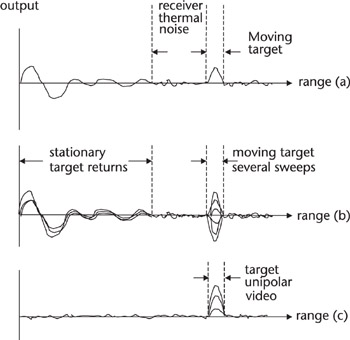
A simplified receiver structure that detects the phase shift from a moving target is depicted and the waveform and response of a delay-line canceller is shown in Figure 11.2.


Figure 11.2: Waveform and response of delay line canceller: (a) phase detector output, single sweep, (b) phase detector output, multiple sweeps, and (c) output of delay line canceller with rectification

The output of the phase detector is applied to a delay-line canceller. The previous return is subtracted from the present return. The output of the canceller is zero for a stationary target or clutter whereas it is nonzero for a moving target.

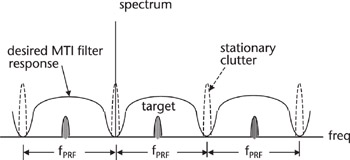
We call the phase detector plus delay-line canceller an moving target indicator (MTI) filter. The desired frequency response of an MTI filter relative to the spectrum of stationary clutter is shown in Figure 11.3.


Figure 11.3: Desired frequency response of an MTI filter

Many techniques are available to realize the delay-line canceller. The canceller may have a nonrecursive or recursive structure. There are cancellers that have the two structures combined. We analyze a few of them...

UNLIMITED FREE
ACCESS
TO THE WORLD'S BEST IDEAS

SUBMIT
Already a GlobalSpec user? Log in.

This is embarrasing...

An error occurred while processing the form. Please try again in a few minutes.

Customize Your GlobalSpec Experience

Category: Optical Triangulation Position Sensors
Finish!
Privacy Policy

This is embarrasing...

An error occurred while processing the form. Please try again in a few minutes.