Radar System Analysis, Design and Simulation

In this chapter, we study the basic principle of array antenna synthesis techniques and show the radiation patterns of several array antennas.
An array antenna may be linear, circular, or elliptical (rectangular). The array antenna may consist of fewer than ten elementary radiating sources arranged in a line or tens to thousands arranged on a planar grid.
The elementary radiator may be a slot on the wall of a rectangular waveguide, a dipole or crossed-dipole on a ground plane, a rectangular pyramidal horn, or an open-ended waveguide. These elementary radiating sources can be arranged in a linear array, a circular aperture, or an elliptical (or rectangular) aperture.
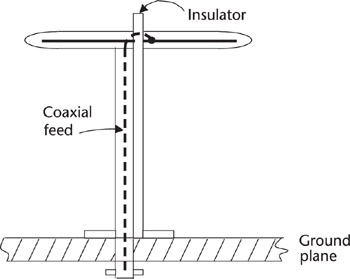
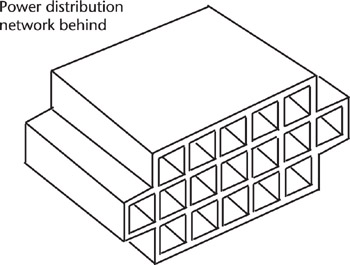
Three examples of the elementary radiator are shown in Figures 6.1 through Figure 6.3 [1 4]. The radiation pattern of an array antenna is the product of the elementary radiator and the array pattern.
A linear array antenna is constructed by arranging the radiating elements on a line. The powers radiating from the elements may be equal or different from one another by design.
To begin our design of a linear array, we take a pair of isotropic radiating point sources arranged as shown in...