Radar System Analysis, Design and Simulation
In this chapter we study the principles of radar target detection. We analyze the probability of detection, the probability of false alarm, the threshold (bias) level and pulse integration. We investigate how to determine the threshold so that a desired detection probability and the false alarm probability are obtained and how many return pulses are to be integrated.
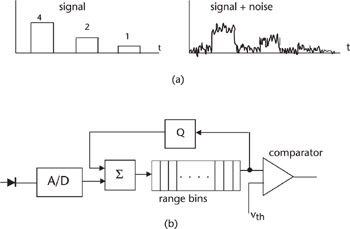
Let us examine a basic structure of pulse integration shown in Figure 7.1. The IF signal plus noise is detected by a diode detector and converted to digital levels by an A/D converter. The digital numbers are stored in a bank of memories through a summer whose other inputs are the fed-back numbers from a scalar Q. The length of the memory bank is equal to the number of range bins of display the indicator (maximum detection range). The feedback path includes the scalar Q that prevents an overflow in the memory bank by dividing the output of memory bank by 1/2, 3/4, 7/8, (N ?1)/N. The output of the range bin memory is sequentially compared with the threshold V Th by a comparator. When the output of the memory exceeds the threshold we declare that a target is present in that range bin; otherwise no target is declared. The basic structure is called a noncoherent recirculating accumulator, or pulse integrator, for short.
Let us examine how the pulse integrator detects a target signal embedded in noise. We simulate three targets: target...