Realistic Image Synthesis Using Photon Mapping
A practical guide to photon mapping, this book provides both the theory and the insight necessary to implement photon mapping and simulate all types of direct and indirect illumination efficiently.
 TABLE OF CONTENTS
 In this section we will introduce radiometry, the basic terminology used to describe light [38]. Radiometry is generally accepted for this purpose, even though photometry is also used. The difference between the two is that photometry takes into account the perception of light by a human observer.
The basic quantity in lighting is the photon. The energy, e ?, of a photon with a wavelength ? is
| (2.1) |  |
where h ? 6.63 10 -34 J s is Planck's constant, and c is the speed of light (in a vacuum c = c 0 = 299,792,458 m/s).
The spectral radiant energy, Q ?, in n ? photons with wavelength ? is
| (2.2) | 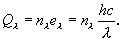 |
Radiant energy, Q, is the energy of a collection of photons and is computed by integrating the spectral energy over all possible wavelengths:
| (2.3) |  |
Radiant flux, ?, is the time rate of flow of radiant energy:
| (2.4) |  |
? is often just called the flux. For wavelength dependence there is the spectral radiant flux, ? ? ,, which is the time rate flow of spectral radiant energy.
The radiant flux area density is defined as the differential flux per differential area (at a surface), d ? /dA. Radiant flux area density is often separated into the radiant exitance, M, which is the flux leaving a surface (this quantity is also...