Realistic Image Synthesis Using Photon Mapping
A practical guide to photon mapping, this book provides both the theory and the insight necessary to implement photon mapping and simulate all types of direct and indirect illumination efficiently.
 TABLE OF CONTENTS
 The radiance estimate derived in the previous chapter allows us to begin rendering images. The first step is building a photon map using photon tracing as described in Chapter 5. This photon map can then be visualized directly (via the radiance estimate) by using a simplified ray tracer. This ray tracer uses the radiance estimate to compute the reflected radiance from all diffuse materials and standard recursive ray tracing for specular materials. This is illustrated in Figure 8.1.
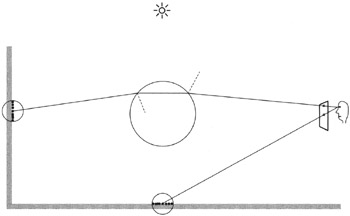
Is this simple visualization a full solution to the rendering equation? To answer this question we can look at the paths traced by the photons and the rays and see if they cover the space of all paths.
L(SD)*D are all the paths represented by the photon map.
(LS*E)(DS*E) are all the paths traced by the ray tracer.
The combination of these paths shows that the method does indeed trace all paths between the eye and the light source. Pure ray tracing handles the case where the light is directly visible or seen through one or more specular reflections. The photon map combined with the ray tracer handles all the cases where there is at least one diffuse reflection between the eye and the light source. In particular, this approach...