Realistic Image Synthesis Using Photon Mapping
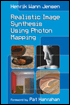
A practical guide to photon mapping, this book provides both the theory and the insight necessary to implement photon mapping and simulate all types of direct and indirect illumination efficiently.
 TABLE OF CONTENTS
 In the previous chapters it was assumed that all photon interactions happen at surfaces. This is only the case in a vacuum. Even clean air scatters photons this is the reason why the sky is blue. Often, we can ignore the presence of clean air in a model, but this is no longer the case for large (outdoor) models or when the air is filled with dust and other particles. Dusty air, clouds, and silty water are all examples of participating media, and the presence of these phenomena requires new light transport techniques.
Another class of participating media is translucent materials such as marble, skin, and plants. To perform a full simulation of the subsurface scattering inside such materials, it is necessary to solve the same basic equations as in the case of general participating media.
Photon mapping is very good at handling participating media, and it was the first method that demonstrated a full simulation of subsurface scattering in graphics [23, 50], and the first method to efficiently simulate volume caustics [48].
Before going into the details of how to use photon mapping in participating media this chapter begins by reviewing the light transport properties of participating media.
When a photon enters a participating medium, it can either continue unaffected through the medium or it can interact with the medium at a given location. When a photon interacts with a medium one of two things can happen: it is either absorbed or scattered.