Realistic Image Synthesis Using Photon Mapping
A practical guide to photon mapping, this book provides both the theory and the insight necessary to implement photon mapping and simulate all types of direct and indirect illumination efficiently.
 TABLE OF CONTENTS
 When describing a light path it is often necessary to distinguish between different types of surface reflections along the path. Heckbert [34] has introduced a compact notation for exactly this purpose. In Heckbert's notation the "vertices" of the light path can be:
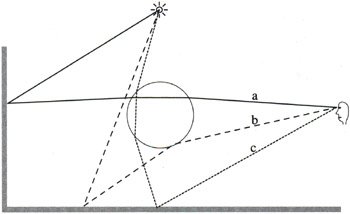
| L | a light source |
| E | the eye |
| S | a specular reflection |
| D | a diffuse reflection |
For example, LDDSE means a path starting at the light source, having two diffuse reflections followed by a specular reflection before reaching the eye. Note that we assume that a BRDF can be composed into a specular-like component and a diffuse-like component. For some applications it may be useful to introduce a glossy, G, reflection also.
To describe combinations of paths it is common to use regular expressions:
| (k)+ | one or more of k events |
| (k)* | zero or more of k events |
| (k)? | zero or one k event |
| (kk') | a k or a k' event |
As an example L(SD)+DE means a path starting at the light source having one or more diffuse or specular reflections before being reflected at a diffuse surface towards the eye.