Realistic Image Synthesis Using Photon Mapping
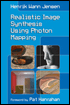
A practical guide to photon mapping, this book provides both the theory and the insight necessary to implement photon mapping and simulate all types of direct and indirect illumination efficiently.
 TABLE OF CONTENTS
 The purpose of this chapter is to give an overview of the photon-mapping approach and give some insight into the reasoning that motivated the development of the method. The presentation here is designed to provide an intuitive understanding; the details will be presented in the following chapters.
Our goal is an algorithm that is capable of efficiently rendering high-quality images of complex models with global illumination. We want an algorithm capable of handling any type of geometry and any type of BRDF.
Pure finite element radiosity techniques do not satisfy our requirements. Radiosity methods suffer from mesh artifacts, have problems with general BRDF representations (in particular specular materials), and they are too costly for complex geometry.
An alternative to pure finite element radiosity is multi-pass techniques that use finite element techniques to compute an initial coarse solution. The final image is then rendered with a Monte Carlo ray-tracing algorithm such as path tracing (see for example [13]). These two-pass methods are faster than pure Monte Carlo ray tracing and generate images of better quality than pure finite element methods, but they suffer from the limitations of the finite element techniques. In particular they cannot deal with complex geometry since the finite element preprocessing becomes too costly. One paper [82] has addressed this issue using geometry simplification, where the finite element algorithm is performed on a coarse representation of the model. This reduces the complexity of the two-pass methods. However, geometry simplification is hard and not an...