Realistic Image Synthesis Using Photon Mapping
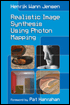
A practical guide to photon mapping, this book provides both the theory and the insight necessary to implement photon mapping and simulate all types of direct and indirect illumination efficiently.
 TABLE OF CONTENTS
 The rendering equation forms the mathematical basis for all global illumination algorithms. It states the necessary conditions for equilibrium of light transport in models without participating media (participating media is described in Chapter 10). The rendering equation can be used to compute the outgoing radiance at any surface location in a model. The outgoing radiance, L o, is the sum of the emitted radiance, L e and the reflected radiance, L r:
| (2.42) |  |
By using Equation 2.18 to compute the reflected radiance we find that:
| (2.43) |  |
This is the rendering equation as it is often used in Monte Carlo ray-tracing algorithms including photon mapping.
For finite element algorithms the rendering equation is normally expressed as an integral over surface locations. This can be done by using the following formula for the differential solid angle:
| (2.44) | 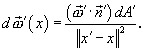 |
Here x' is another surface location, and  is the normal at x'. By introducing a geometry term G where
| (2.45) | 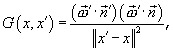 |
we can rewrite the rendering equation as:
| (2.46) |  |
Here we have used the notation L i( x' ? x) to denote the radiance leaving x' in the direction towards x, S is the set of all surface points, and V( x, x') is a visibility function:
| (2.47) |  |
We can formulate the rendering equation entirely in terms of surface locations x, x', and x":
| (2.48) |  |
This is very similar to the original rendering equation as presented...