Realistic Image Synthesis Using Photon Mapping
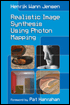
A practical guide to photon mapping, this book provides both the theory and the insight necessary to implement photon mapping and simulate all types of direct and indirect illumination efficiently.
 TABLE OF CONTENTS
 In the previous chapters a number of tools and techniques were developed for building and using a photon map. In this chapter we show how to combine these techniques into an efficient and practical two-pass algorithm [42]. In this chapter we will ignore the presence of participating media (techniques for handling participating media are presented in Chapter 10).
The two steps in the algorithm are:
Pass 1 : Building the photon maps using photon tracing.
Pass 2 : Rendering using these photon maps.
Unlike the previous chapter, the rendering method here is a distribution ray tracer that computes both the direct and the indirect illumination (except for caustics). This makes it possible to render accurate images using a small number of photons.
We first show mathematically how to split the rendering equation into several components that can be computed separately. In the following sections, we describe how each of these components can be evaluated efficiently.
As shown in Section 2.5 the outgoing radiance, L o, at a given surface location, x, can be computed as:
| (9.1) |  |
where the reflected radiance, L r, is computed by the following integral:
| (9.2) |  |
To evaluate this integral efficiently it is worth considering the properties of the BRDF, f r, and the incoming radiance, L i.
The BRDF is often a combination of two components: a smooth (diffuse) and a sharp (specular) component. This information is very useful when evaluating the...