Realistic Image Synthesis Using Photon Mapping
A practical guide to photon mapping, this book provides both the theory and the insight necessary to implement photon mapping and simulate all types of direct and indirect illumination efficiently.
 TABLE OF CONTENTS
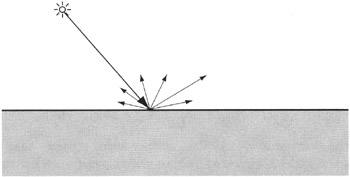
 When light encounters an obstacle it is either scattered or absorbed. The obstacle can be the surface of a different material or medium. It can also be a very small particle or a molecule, but this case requires special scattering techniques which we will describe in Chapter 10. In this section we will introduce tools for modeling the local light scattering at surfaces: i.e., what happens when a beam of light strikes a given surface. In graphics this is also known as local illumination.
First we present the theoretical framework used to describe light scattering, and then we present a few reflection models commonly used in computer graphics. Unless stated we assume that the wavelength of light does not change as a result of scattering (i.e., fluorescence), and we therefore omit the wavelength parameter in our description.
When a beam of light is scattered by a material it normally enters the material and then scatters around before leaving the surface at a different location. This is particularly noticeable for translucent materials such as marble and skin, but it happens to some degree for all non-metallic materials. We can describe this scattering using the Bidirectional Scattering Surface Reflectance Distribution Functional BSSRDF [69]. The BSSRDF, S, relates the differential reflected radiance, dL r, at x in direction  , to the differential incident flux, d ? i at x' from direction
  : [1]
: [1]