Semiconductor Heterojunctions and Nanostructures

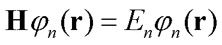
This chapter deals with particles in time-independent potential barriers and wells. The quantum effects such as transmission through barriers (tunneling) and energy quantization should increase when the potential barrier varies over a distance shorter than the wavelength of the quantum particle (either photon or electron). The time-independent Schr dinger equation with an arbitrary potential was discussed briefly in Sec. 1.5. In order to distinguish between the various possible values of the energy and the corresponding eigenfunctions, we label them with a quantum number n such that the Schr dinger equation can be written as
| (2.1) | |
and the stationary state of the particle has a wave function with the form
| (2.2) | |
where ? n( r, t) is a solution to the Schr dinger equation [Eq. (2.1)]. The exponential
is factored out in the Schr dinger equation, and Eq. (2.2) is still called a time-independent wave function. Since Eq. (2.1) is linear, it has other solutions of the form
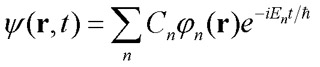
| (2.3) | |
where C n are arbitrary complex numbers. In this chapter, we consider only one-dimensional systems where the potentials are presented by functions that make discontinuities along the x coordinate. These functions may or may not represent real physical potentials, but we shall use them for illustration on how to obtain the eigenvalues and eigenfunctions.
Consider the potential step shown in Fig. 2.1 and consider that a particle with a mass m is traveling from left to right...