Semiconductor Heterojunctions and Nanostructures

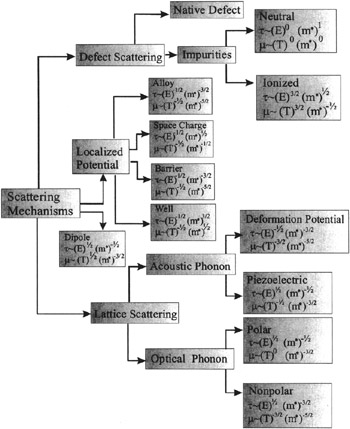
There are several scattering mechanisms that play major roles in the determination of carrier mobilities and conductivities in semiconductors. These mechanisms are summarized in Fig. 7.21. This figure lists the scattering relaxation time as a function of the energy and the effective mass of the charge carrier. The mobility as a function of the sample temperature and the effective mass of the carrier is also shown in the figure. This figure does not include electron-electron or electron-hole scattering. The carrier-carrier scatterings become important in heavily doped semiconductors where impact ionization and Auger processes are significant. The theoretical analyses of scattering processes are usually treated using quantum mechanics. The Fermi golden rule is employed to calculate the scattering rate or the transition matrix element when the charge carrier is scattered from one state to another.
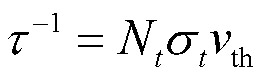
The general procedure of the calculation is to identify the scattering potential, and then to use first-order perturbation theory to calculate the transition matrix element. The scattering relaxation time can be obtained from the following relation:
| (7.150) | |
| where N t | = density of total scattering centers |
| ? t | = total scattering cross section |
| v th | = average thermal velocity =... |