Semiconductor Heterojunctions and Nanostructures

Electric currents in semiconductors are due to the net flow of electrons and holes under bias voltages, and transport is the process that describes the motion of the charged particles. The two major transport processes are the drift and diffusion mechanisms. The drift mechanism is basically the movement of charged carriers under the influence of applied electric fields, and the diffusion mechanism is the flow of charged particles due to the density variation. Transport properties in semiconductors can be very complicated, depending on the actual size of the samples. Thus, it is worth discussing the classical and quantum limitations and regimes.
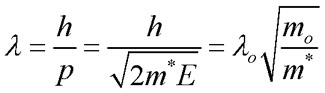
In order to define the limits of various transport regimes, one may scale the size of the sample against the de Broglie wavelength. This de Broglie wavelength ? can be expressed, as an example, for an electron traveling with a thermal kinetic energy in a semiconductor as
| (7.1) | |
| where h | = Plank's constant |
| p | = momentum |
| E | = energy |
| ? o | = de Broglie wavelength of a free electron |
| m* | = electron effective mass in semiconductor |
The room temperature de Broglie wavelength of a free electron is ~76 , and that of an electron in GaAs is 295 . The de Broglie wavelength for a selection of semiconductor materials is plotted as a function of the electron effective mass, as shown in Fig. 7.1. The range of de Broglie wavelengths in this figure spans 660 to 167 . For temperatures as low as 4.2 K, the...