Semiconductor Heterojunctions and Nanostructures

7.2: The Hall Effect

7.2 The Hall Effect

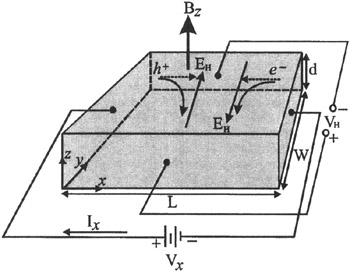
Historically, Hall-effect measurements have been used extensively in determining majority carrier concentrations and their mobilities in bulk and thin-film materials, Two-dimensional electron gases formed in quantum wells and at heterojunction interfaces have been investigated by this technique. Electric and magnetic fields are essential to observe this effect. A sketch of the sample configuration is shown in Fig. 7.4. The motions of the electrons and holes under the influence of the electric and magnetic forces are shown. The configuration in this figure is constructed such that the electric current follows along the x axis, while the magnetic field is in the z direction. The force on both electrons and holes is in the - y direction. In an n-type semiconductor, where the majority carriers are electrons, there is a buildup of negative charges at the y = 0 surface. For p-type material, positive charge buildup is also at the y = 0 surface. The net change produces an electric field in the + y direction.


Figure 7.4: A sketch of a sample under the influence of electric and magnetic fields. This configuration is called the Hall bar.

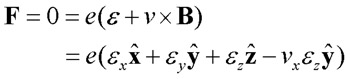
In the steady-state case, the magnetic force is balanced by the electric force such that the net force is zero and can be expressed as

(7.3)

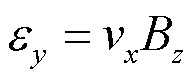
This equation yields

(7.4)

where v x is the drift velocity in the x direction. The electric field along the y direction expressed...

UNLIMITED FREE
ACCESS
TO THE WORLD'S BEST IDEAS

SUBMIT
Already a GlobalSpec user? Log in.

This is embarrasing...

An error occurred while processing the form. Please try again in a few minutes.

Customize Your GlobalSpec Experience

Category: Magnetometers
Finish!
Privacy Policy

This is embarrasing...

An error occurred while processing the form. Please try again in a few minutes.