Semiconductor Heterojunctions and Nanostructures

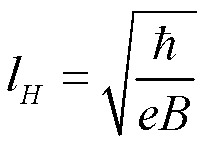
Quantum transport in low-dimensional semiconductor systems is very interesting and offers the investigation of remarkable properties, such as the quantum Hall effect, the Shubnikov-de Haas effect, ballistic transport, and the fractional quantum Hall effect. For example, the Shubnikov-de Haas effect allows one to precisely measure the carrier concentrations formed at heterojunction interfaces. The investigation of two-dimensional systems in a perpendicular magnetic field provides quantization in Hall resistance (Klitzing et al. 1980), which results from the quantization of the energy in a series of Landau levels. The Landau magnetic length l H (also known as the cyclotron radius of the lowest Landau energy level) assumes the role of wavelength in the quantum Hall effect, which is given by
| (7.24) | |
For B = 10 T, the magnetic length is l H ? 8.12 nm.
The original quantum Hall-effect device geometry used by Klitzing et al. (1980) is shown in Fig. 7.6 a. The quantum Hall effect (QHE) measurements are made by probing the Hall voltage across points 1 and 2, while the Shubnikov-de Haas (SdH) measurements are made by probing the voltage across points 1 and 3. The device is symmetrical such that the QHE can be measured across points 3 and 4 and SDH measurements can be obtained across points 2 and 4. The initial QHE measurements were made on a Si metal-oxide semiconductor field-effect transistor as schematically shown in Fig. 7.6 b. A two-dimensional electron gas (2DEG) is...