7.5 Boltzmann Transport Equation
When charge carriers, such as electrons in semiconductors, are at equilibrium (absence of external perturbations), their statistical distribution obeys the Fermi-Dirac distribution function  given by
| (7.105) | 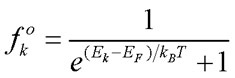
|
where E F is the Fermi energy level and k B is the Boltzmann constant. When electrons are subjected to an external perturbation such as an applied electric field, diffusion, or scattering, their distribution function is no longer described by the Fermi-Dirac function, but by a function f k that depends on time, space, and momentum. The Boltzmann approach is used to evaluate the behavior of the nonequilibrium distribution function f k with time. The evolution of f k as a function of time due to scattering, diffusions, and an external field can be written as
| (7.106) | 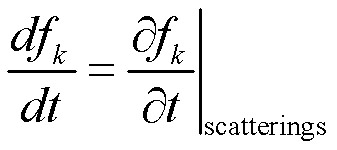
|
This equation is known as the Boltzmann equation. Since f k is a function of time, r, and k, the total derivative can be expanded as follows:
| (7.107) | 
|
Since
| (7.108) | 
|
where v is the electron velocity and ? is the external force acting on the system. Substituting Eqs. (7.108) into (7.106) and knowing that
| (7.109) | 
|
we have
| (7.110) | 
|
This equation is known as the Boltzmann transport equation. The term labeled "scattering" represents the distribution function due to scattering between electrons and their surroundings, which can be denned as
| (7.111) | 
|
where the term (1 - f k) represents the probability of having a vacancy in the state k, the term (1...


 TABLE OF CONTENTS