Semiconductor Heterojunctions and Nanostructures

Chapter 3: Electronic Energy Levels in Periodic Potentials

Overview

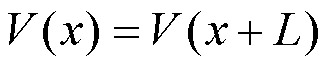
This chapter focuses on the discussion of quantum mechanics of a single electron in a periodic potential. It is difficult to find such a system, but the closest example is that of a free electron in a solid single crystal. The free electron here means that there is only one electron in the conduction band of the crystal. This simplistic example requires that the atoms of the single crystal be perfectly arranged in a single lattice and the electron-electron interactions be ignored. Such a one-electron single-crystal approximation leads to a description of allowed electronic energy levels in the crystal under the constraints of the Pauli exclusion principle and Fermi-Dirac statistics. This approximation is actually the foundation of most theoretical analyses of crystalline solids. Based on this foundation, there are other approximations such as the absence of imperfections in the single crystal, the tight-binding method, and the effective mass approximation. For the one-electron single-crystal approximation to work, the periodic potential must satisfy the following relation assuming a one-dimensional crystal:

(3.1)

where L is the period of the potential. The periodic potential could be square-shaped, a ?-function, or any arbitrary shape that repeats itself in a periodic fashion and has the same periodicity of the lattice. The Schr dinger equation of the one-electron single crystal can be written as

(3.2)

If V( x) is a periodic function, then (2 m/ ? 2)[ E n - V( x)] must be periodic. A...

UNLIMITED FREE
ACCESS
TO THE WORLD'S BEST IDEAS

SUBMIT
Already a GlobalSpec user? Log in.

This is embarrasing...

An error occurred while processing the form. Please try again in a few minutes.

Customize Your GlobalSpec Experience

Category: Wafer and Thin Film Instrumentation
Finish!
Privacy Policy

This is embarrasing...

An error occurred while processing the form. Please try again in a few minutes.