Semiconductor Heterojunctions and Nanostructures

The tunneling phenomenon was briefly discussed in Chap. 2 for a single potential barrier, single potential well, and a double-barrier structure. This effect was first reported by Esaki in a narrow germanium pn junction (see Esaki 1959). Currently, there are many devices based on the tunneling effect such as resonant tunneling diodes, point contact diodes, Schottky diodes, bipolar transistors, and field-effect transistors. One important aspect of the tunneling effect is that the tunneling time of carriers is proportional to the function exp(-2 ? L), where ? is the decaying wave vector inside the barrier and L is the width of the potential barrier. The wave functions of the tunneling carriers are characterized as propagating waves in the wells and evanescent waves inside the barriers. In this chapter, we will discuss examples that are relevant to semiconductor heterojunctions and nanostructures.
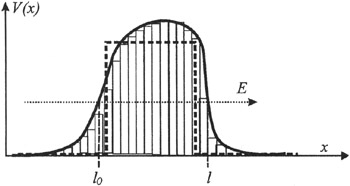
In Sec. 2.2 we showed the form of the transmission coefficient for a particle tunneling through a rectangular barrier. When the product of the decaying wavevector and the width of the barrier is much larger than unity, the transmission coefficient is approximated by Eq. (2.34). For a potential barrier with an arbitrary shape as depicted in Fig. 4.1 (solid line), the exact derivation of the transmission coefficient becomes more complicated. It can be obtained with the help of approximation methods. For example, the WKB method becomes very handy in obtaining an approximate form of the tunneling probability.