Statistical and Thermal Physics: Fundamentals and Applications

Chapter 9: Ideal Gases and Solutions

One of the most beautiful hypotheses ever propounded in physics is the Dynamical Theory of Gases.

Simon Newcomb, 1861.

9.1 Ideal Monatomic Gases: Introduction

In the last chapter, we showed that the distinction between bosons and fermions vanishes in the low density (ideal) limit, and that the mean occupancy of the energy levels of an ideal gas of either particle is given by the Maxwell-Boltzmann distribution (Equation (8.12))


where ? is the chemical potential and ? ( ?e ? ? ) is the activity. In deriving Equation (8.12), we assumed that the gas consists of particles with no internal structure other than spin; that is, we assumed a monatomic gas such as helium. Later in this chapter, we extend our treatment to ideal polyatomic gases.

The activity ? is very simply related to the particle density n. For a three-dimensional monatomic gas, Equation (8.15) gives


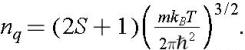
where n q is the quantum concentration given by Equation (6.31),


In this chapter, we explore the experimental consequences of these results, and extend them to polyatomic ideal gases. It should always be remembered that the results only apply when ? ?1.

9.2 The Maxwell Distribution: Velocity Distribution in an Ideal Gas

One result that we can obtain right away is the distribution of molecular energies and velocities. The probability that a molecule has an energy between E and E+ dE is, from Equation (6.1),


where we write Z 1 rather than

UNLIMITED FREE
ACCESS
TO THE WORLD'S BEST IDEAS

SUBMIT
Already a GlobalSpec user? Log in.

This is embarrasing...

An error occurred while processing the form. Please try again in a few minutes.

Customize Your GlobalSpec Experience

Category: Chemical Process and Petrochemical Gases
Finish!
Privacy Policy

This is embarrasing...

An error occurred while processing the form. Please try again in a few minutes.