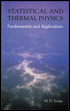
Statistical and Thermal Physics: Fundamentals and Applications
We shall now work out...the equation of state of the (perfect) gas on the assumption that the solution with antisymmetrical eigenfunctions is the correct one.
Paul Dirac, 1926
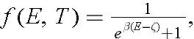
We now turn to the perfect gas of fermions, which obey the Pauli principle and whose distribution function is given by Equation (8.3):
where the chemical potential ? is a function of the particle density. We are interested in the degenerate gas; that is, one whose density is so high that n> n q, so that 1 cannot be neglected in the denominator of Equation (8.3). We have seen in Chapter 8 that for such a gas ? is positive, and for most of this chapter we confine our attention to the limit in which ? is close to its T=0 value, the Fermi energy E F.
The most important degenerate Fermi gas is the electron gas in metals and in white dwarf stars. Another case is the neutron star, whose density is so high that the neutron gas is degenerate (see Problem 12.8(e)). Here we concentrate on the electron gas.
We start from the Drude [1] model of a metal. This model, which preceded quantum theory, accounted for the high electrical and thermal conductivity of a metal by assuming that when the constituent atoms are brought together, their outer electrons break away and can move freely through the solid. Thus, a metal contains a large...