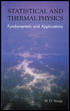
Statistical and Thermal Physics: Fundamentals and Applications
Appendix A: Expansion in Series

A.1 The Use of Infinite Series in Physics

One of the most powerful mathematical tools in the physicist s armory is expansion of an analytic ( smooth ) function in a series of ascending powers of a small parameter. While infinite series form an important part of any undergraduate mathematical curriculum, a physicist looks at series from a point of view somewhat different than that of most mathematicians.

Suppose that we have analyzed some physical phenomenon and have found a function that describes it. Initially we will assume that it is a function of a single variable which we call f(x) (Section A.5 extends the analysis to functions of multiple variables). Often this function is inconveniently complicated in general, but is simple for a certain special value of its argument. Series expansion provides a simple expression for its behavior close that value. As we shall see, the question of convergence, which dominates the discussion of infinite series in most textbooks of mathematics, is rarely important in physics.

A.2 The Taylor-McLaurin and Binomial Series

By the right choice of variable, we can take the special value of x to be zero with no loss of generality, and we assume that f(x) is analytic in the region x=0; a function is analytic in a certain domain if all its derivatives exist in that domain. This is not true of all functions; for example x a is not analytic at x=0 unless a is a non-negative integer, and...

UNLIMITED FREE
ACCESS
TO THE WORLD'S BEST IDEAS

SUBMIT
Already a GlobalSpec user? Log in.

This is embarrasing...

An error occurred while processing the form. Please try again in a few minutes.

Customize Your GlobalSpec Experience

Category: IC Electronic Filters
Finish!
Privacy Policy

This is embarrasing...

An error occurred while processing the form. Please try again in a few minutes.