Statistical and Thermal Physics: Fundamentals and Applications

Appendix D: Some Results in Probability Theory

D.1 Derivation of the Binomial Coefficients c(N, r)

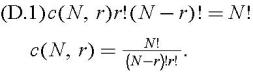
The binomial coefficient c(N, r) is the coefficient of x r y N ?r in the expansion of (x + y) N , and can be obtained as follows. Think of the product of N brackets (x+ y)(x+ y) . When you multiply the brackets out, you get a term in x r y N ?r by taking x from r of the brackets and y from the rest. How many of these terms are there? Think of each bracket as an object which is assigned either to the x pile (containing r objects) or the y pile (containing N ? r). We do not care in what order the objects are assigned. The number of terms in x r y N ?r is simply the number of different ways the assignment can be made; call this number c(N, r). Now suppose that the objects are labelled and we distinguish between different orderings of them. The r objects in the x pile can be permuted to give r! orderings, [1] and those in the y pile (N ?r)! orderings. The product c(N, r)r! (N ?r)! is the total number of orderings of N objects, which is N!. Hence,


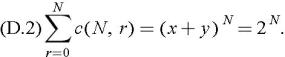
Putting gives


This derivation of c(N, r) can be...

UNLIMITED FREE
ACCESS
TO THE WORLD'S BEST IDEAS

SUBMIT
Already a GlobalSpec user? Log in.

This is embarrasing...

An error occurred while processing the form. Please try again in a few minutes.

Customize Your GlobalSpec Experience

Category: Color Meters and Appearance Instruments
Finish!
Privacy Policy

This is embarrasing...

An error occurred while processing the form. Please try again in a few minutes.