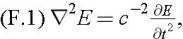
In the text we consider two types of wave: an electromagnetic wave, associated with photons, and particle waves. In this appendix, we further assume that there are no media or potentials, and look only for stationary solutions of the wave equation; that is, for standing rather than for propagating waves. In free space, the electromagnetic field E(x, y, z, t) obeys the equation of wave motion
where the Laplacian operator  .
.
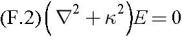
If we assume a time dependence e i ?t, we obtain the Helmholtz equation for E(x, y, z)
where  .
.
The particle wave function ?(x, y, z) obeys Schr dinger s time-independent equation, which in free space reduces to Equation (F.2) with E replaced by ? and ? by  , where E is the energy of the particle.
In this treatment, we ignore the vector nature of the electromagnetic field, substitute ? for E in Equation (F.2), and look for solutions that satisfy the condition that ?=0 at the boundaries.
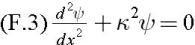
We first consider the one-dimensional problem; for example, waves on a string of length L fixed at both ends, or particles in a box. Then Equation (F.2) becomes
with the general solution
where A and B are constants.
We now apply the boundary conditions ?(0)=0, ?(L)=0. Since cos(0)=1, the first condition requires that B=0. The second condition requires that sin ?L=0, and thus restricts the possible values of ?
Copyright A K Peters, Ltd. 2003 under license agreement with Books24x7

 TABLE OF CONTENTS