11.1 Conserved Bosons
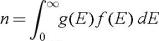
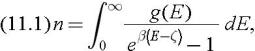
We now turn to the other type of boson: a particle, such as an atom or molecule, with integer or zero spin, whose number is conserved. As in the case of the ideal gas, we integrate the distribution function over all the states to obtain a relation between particle density n and the chemical potential ?. The density is, from Equation (8.4),
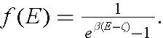
where, from Equation (8.10),
Hence,
or, in terms of the activity ?,
Note that the integral is finite only if ? ?1 ?1, so that ? must be negative or zero for a boson gas.
For three-dimensional nonrelativistic particles with spin S, the density of states per unit volume is given by Equation (6.19):
Substituting g(E) from Equation (6.19) in Equation (11.1), and putting x= ?E, we obtain
Equation (11.3) differs from the corresponding ideal gas result because ?1 can no longer be neglected in the denominator, so that e ? ? (that is, ?) can no longer be taken outside the integral.
Since ? ?0, the maximum possible value of the integral in Equation (11.3) is obtained when ?=0 and is (see Problem 11.1)
Thus, according to Equation (11.3), there is at any given temperature a maximum possible...

 TABLE OF CONTENTS