Statistical and Thermal Physics: Fundamentals and Applications

Chapter 13: Electrons and Holes in Semiconductors

The technology which has transformed practical existence is largely an application of what was discovered by allegedly irresponsible (natural) philosophers.

Sir Cyril Hinshelwood

It has today occurred to me that an amplifier using semiconductors rather than vacuum is in principle possible.

Entry in William Shockley s laboratory notebook, Dec 29, 1939.

13.1 Metals, Insulators, and Semiconductors

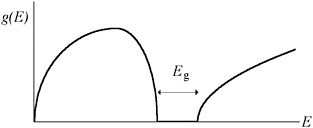
In Chapter 12, we treated the electrons in a metal as if they were free, except for the confining potential which keeps them within the metal. This is a drastic assumption, which is valid as a rough approximation in most metals, but is not valid, even qualitatively, for an insulator or semiconductor. In a real solid, the electrons move in the rapidly varying potential of the atoms, and the density of states g(E) is more complicated than the free electron value given by Equation (6.20). In general, there are regions of energy, called bandgaps or energy gaps (or gaps), where there are no states. [1] The regions of energy where g(E) ?0 are called energy bands, which are separated by gaps where g(E) =0. A density of states with such a gap is illustrated schematically in Figure 13.1. The width of the gap is denoted E g .


Figure 13.1: Schematic density of states g(E) in a solid. E g is the width of the bandgap.

In a metal at T=0, the states are filled up to the Fermi energy E F, and...

UNLIMITED FREE
ACCESS
TO THE WORLD'S BEST IDEAS

SUBMIT
Already a GlobalSpec user? Log in.

This is embarrasing...

An error occurred while processing the form. Please try again in a few minutes.

Customize Your GlobalSpec Experience

Category: Semiconducting Materials
Finish!
Privacy Policy

This is embarrasing...

An error occurred while processing the form. Please try again in a few minutes.