Statistical and Thermal Physics: Fundamentals and Applications
Appendix B: Review of Quantized States

B.1 Introduction: Wave-Particle Duality and the Dispersion Relation for a Particle

There are many experiments that show that a particle is associated with a wave, whose intensity (that is, the squared amplitude) at any point is proportional to the probability of observing a particle at that point. [1] The most direct is electron diffraction: A beam of free electrons with velocity ? is diffracted from a periodic structure (such as a crystal) as if the beam were a plane wave with wavelength , where p= m ? is the momentum and h is Planck s constant. This is known as the de Broglie relation, and ? is the de Broglie wavelength. It is often convenient to write this relation as p= ?k, where and . This relation between wavelength and momentum applies to any particle.

For a nonrelativistic particle, the kinetic energy is , so that in the absence of a potential, the particle has energy


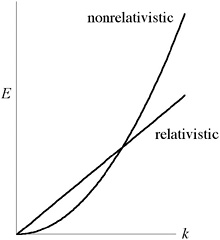
A relation such as Equation (B.1), which relates the energy E to k, is called a dispersion relation. Two typical dispersion relations, one for a free nonrelativistic particle such as a molecule moving at an ordinary thermal velocity in a gas, and the other for an extreme relativistic particle such as the photon, are shown in Figure B.1.


Figure B.1: Dispersion relations for free relativistic and nonrelativistic particles.

Here we briefly summarize the stationary states (quantum states) of a particle for some simple...

UNLIMITED FREE
ACCESS
TO THE WORLD'S BEST IDEAS

SUBMIT
Already a GlobalSpec user? Log in.

This is embarrasing...

An error occurred while processing the form. Please try again in a few minutes.

Customize Your GlobalSpec Experience

Category: Wavelength Meters
Finish!
Privacy Policy

This is embarrasing...

An error occurred while processing the form. Please try again in a few minutes.