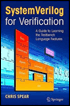
SystemVerilog for Verification: A Guide to Learning the Testbench Language Features
Chapter 4: Basic OOP

4.1 Introduction

With procedural programming languages such as Verilog and C, there is a strong division between data structures and the code that uses them. The declarations and types of data are often in a different file than the algorithms that manipulate them. As a result, it can be difficult to understand the functionality of a program, as the two halves are separate.

Verilog users have it even worse than C users, as there are no structures in Verilog, only bit vectors and arrays. If you wanted to store information about a bus transaction, you would need multiple arrays: one for the address, one for the data, one for the command, and more. Information about transaction N is spread across all the arrays. Your code to create, transmit, and receive transactions is in a module that may or may not be actually connected to the bus. Worst of all, the arrays are all static, so if your testbench only allocated 100 array entries, and the current test needed 101, you would have to edit the source code to change the size and recompile. As a result, the arrays are sized to hold the greatest conceivable number of transactions, but during a normal test, most of that memory is wasted.

Object Oriented Programming (OOP) lets you create complex data types and tie them together with the routines that work with them. You can create testbenches and system-level models at a more abstract level by calling routines to perform an action rather...

UNLIMITED FREE
ACCESS
TO THE WORLD'S BEST IDEAS

SUBMIT
Already a GlobalSpec user? Log in.

This is embarrasing...

An error occurred while processing the form. Please try again in a few minutes.

Customize Your GlobalSpec Experience

Category: Programming Languages
Finish!
Privacy Policy

This is embarrasing...

An error occurred while processing the form. Please try again in a few minutes.