SystemVerilog for Verification: A Guide to Learning the Testbench Language Features

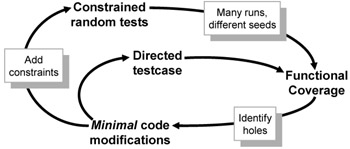
As designs become more complex, the only effective way to verify them thoroughly is with constrained-random testing (CRT). This approach elevates you above the tedium of writing individual directed tests, one for each feature in the design. However, if your testbench is taking a random walk through the space of all design states, how do you know if you have reached your destination? Whether you are using random or directed stimulus, you can gauge progress using coverage.
Functional coverage is a measure of which design features have been exercised by the tests. Start with the design specification and create a verification plan with a detailed list of what to test and how. For example, if your design connects to a bus, your tests need to exercise all the possible interactions between the design and bus, including relevant design states, delays, and error modes. The verification plan is a map to show you where to go. For more information on creating a verification plan, see Bergeron (2006).
Use a feedback loop to analyze the coverage results and decide on which actions to take in order to converge on 100% coverage. Your first choice is to run existing tests with more seeds; the second is to build new constraints. Only resort to creating directed tests if absolutely necessary.
Back when you exclusively wrote directed tests, the verification planning was limited. If the design specification listed 100 features, all you had to do was write 100 tests.