Digital Integrated Circuit Design from VLSI Architectures to CMOS Fabrication
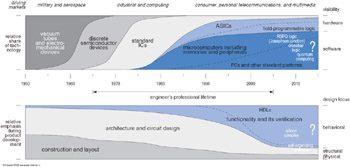
Over the last few decades, we have witnessed dramatic evolution and changes in electronics. Figure 13.1 outlines these changes by illustrating
The displacement of the key driving markets,
The rise and demise of electronic devices and implementation technologies, and
The shift of focus from device-level circuit design and physical construction to defining and verifying the functionality that sells best. [1]
As a result, engineers and project managers have never before been presented with so many alternative choices for implementing their circuits and systems. This holds true in spite of the fact that fabrication technology has narrowed down to CMOS in almost all digital applications. Abstracting from lower-level options and commercial products, table 13.1 shows the fundamental options in a highly condensed form.
| Nonprogrammable standard parts exclusively | Microor digital signal processor | Field- programmable logic (FPL) | Semi-custom ASIC | Full-custom ASIC | ||
|---|---|---|---|---|---|---|
| cell-based | hand layout | |||||
| when introduced | early 1960s | early 1970s | late 1980s | early 1980s | early 1980s | |
| significance today future prospects | low none | high steady | medium rising | medium steady | medium steady | low declining |
While there was a time when components used to be very basic and available with a limited choice, today s integration densities have led to a diversification into an almost astronomical number of powerful and...