Digital Integrated Circuit Design from VLSI Architectures to CMOS Fabrication
The prime objective of this chapter is to put VLSI design and test engineers in a position to understand how MOSFETs, diodes, and contacts operate as part of digital circuits. Readers shall also be enabled to study, understand, and sketch layout drawings and circuit cross sections. Neither a comprehensive insight into solid-state physics nor overly detailed information on a specific fabrication process is necessary for doing so. It generally proves sufficient to distinguish between a handful of materials and to know in what order these are being manufactured and patterned. This is precisely what the present text attempts to convey.
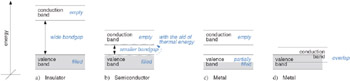
All solids have energy bands which indicate at what levels of energy electrons can exist. Only the conduction band, the uppermost, and the valence band, the next one beneath, are relevant here, see fig. 14.1. Their separation, that is the amount of energy necessary to transfer an electron from the valence band to the conduction band, is known as the bandgap. The relative locations of valence and conduction bands largely determine a material s electrical characteristics.
Insulators. The valence band is fully occupied whereas the conduction band is empty; an important bandgap of typically more than 5 eV separates the two. The valence electrons form strong bonds between adjacent atoms. As these bonds are difficult to break, there are...