Digital Integrated Circuit Design from VLSI Architectures to CMOS Fabrication
A computation is said to be timewise recursive or recursive for short if it somehow depends on an earlier outcome from that very computation itself, a circumstance that gets reflected in the DDG by the presence of a feedback loop. Yet, recall that circular paths of weight zero have been disallowed to exclude the risk of race conditions. Put differently, circular paths do exist but each of them includes at least one latency register.
This section examines equivalence transforms that apply specifically to recursive computations. We will find that such transforms are not universal. This is why we address linear time-invariant, linear time-variant, and nonlinear computations separately.
Consider a linear time-invariant first-order recursive function
which, in the z domain, corresponds to transfer function
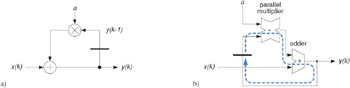
The corresponding DDG is shown in fig. 2.27a. Many examples for this and similar types of computations are found in IIR filters, DPCM [57] data encoders, servo loops, etc.
Recursion demands that the result from the actual computation cycle be available no later than the next input sample. The longest path defined by all computations that are part of the loop must, therefore, not exceed one sampling interval. In the occurrence
As long as this iteration bound is satisfied by the isomorphic architecture of fig. 2.27b implemented using some available and affordable technology, there is...