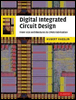
Digital Integrated Circuit Design from VLSI Architectures to CMOS Fabrication
Chapter 5: The Case for Synchronous Design

5.1 Introduction

Experience tells us that malfunctioning digital circuits and systems often suffer from timing problems. Symptoms include

  • Bogus output data,

  • Erratic operation, typically combined with a

  • Pronounced sensitivity to all sorts of variabilities such as PTV and OCV.

Erratic operation often indicates that the circuit operates at the borderline of a timing violation. Searching for the underlying causes not only is a nightmare to engineers but also causes delays in delivery and undermines the manufacturer s credibility. [1]

Observation 5.1

To warrant correct and strictly deterministic circuit operation, it is absolutely essential that all signals have settled to a valid state before they are admitted into a storage element (such as a flip-flop, latch or RAM).

This truism implies that all combinational operations and all propagation phenomena involved in computing and transporting some data item must have come to an end before that data item is being locked in a memory element. Data that are free to change theirs values at any time are dangerous because they may give rise to bogus results and/or may violate timing requirements imposed by the electronic components involved. [2] Hence the need for regulating all state changes and data storage operations.

Many schemes for doing so have been devised over the years, see fig. 5.1. From a conceptual perspective, we must distinguish between two diametrically opposed alternatives, namely synchronous clocking and self-timed operation. A third category that includes all unstructured ad hoc clocking styles occasionally referred to...

UNLIMITED FREE
ACCESS
TO THE WORLD'S BEST IDEAS

SUBMIT
Already a GlobalSpec user? Log in.

This is embarrasing...

An error occurred while processing the form. Please try again in a few minutes.

Customize Your GlobalSpec Experience

Category: Network Test Equipment
Finish!
Privacy Policy

This is embarrasing...

An error occurred while processing the form. Please try again in a few minutes.