Digital Integrated Circuit Design from VLSI Architectures to CMOS Fabrication
The driving force behind the rapid expansion of the microelectronics industry is its aspiration to offer ever more powerful circuits at lower unit prices. From different perspectives, sections 15.1 through 15.4 attempt to find out how and for how long this trend may be expected to continue into the future. The impact of the galloping progress of semiconductor fabrication technology on VLSI design practices is discussed in section 15.5.
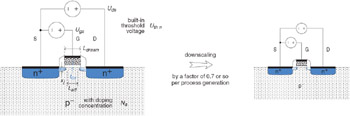
During the past decades, microelectronics has continuously and rapidly evolved according to the motto smaller, faster, cheaper . [1] The reason why this has been possible is the scaling property of CMOS technology first stated by Robert Dennard and his colleagues in 1972 [414]. They observed that MOSFETs would continue to behave largely in the same way provided their geometric dimensions and voltage levels could be made to shrink in a linear fashion so as to maintain constant electric fields, see fig. 15.1. Better still, they predicted that key figures of merit like gate delay and energy efficiency would greatly benefit from downscaling. The question is
For how long can CMOS scaling continue and where does this trend lead to?
The driving force behind moving from one process generation to the next is to lower fabrication costs per device and per circuit by shrinking geometries so as to obtain more paying circuits from a wafer of...