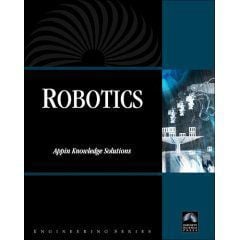
 | This up-to-date text/reference is designed to present the fundamental principles of robotics with a strong emphasis on engineering applications and industrial solutions based on robotic technology. It can be used by practicing engineers and scientists - or as a text in standard university courses in robotics. The book has extensive coverage of the major robotic classifications, including Wheeled Mobile Robots, Legged Robots, and the Robotic Manipulator. A central theme is the importance of kinematics to robotic principles. The book is accompanied by a CD-ROM with MATLAB simulations, photographs, tutorials, and third-party software (see About the CD-ROM section). |
 TABLE OF CONTENTS
 Robotics
Chapter 4 Wheeled Mobile Robots
In This Chapter
- Introduction
- Classification of Wheeled Mobile Robots (WMRs)
- Kinematics and Mathematical Modeling of WMRs
- Control of WMRs
- Simulation of WMRs Using Matlab
- The Identification and Elimination of the Problem
- Modifying the Model to Make the Variation in Delta Continuous
- Developing the Software and Hardware Model of an All-Purpose Research WMR
4.1 INTRODUCTION
Wheeled Mobile Robots (WMRs) have been an active area of research and development over the past three decades. This long-term interest has been mainly fueled by the myriad of practical applications that can be uniquely addressed by mobile robots due to their ability to work in large (potentially unstructured and hazardous) domains.
WMRs are increasingly present in industrial and service robotics, particularly when flexible motion capabilities are required on reasonably smooth grounds and surfaces. Several mobility configurations (wheel number and type, their location and actuation, single- or multibody vehicle structure) can be found in the applications.
Mobile robots have quite simple mathematical models to describe their instantaneous motion capabilities; especially compared to serial, parallel, and humanoid robots. However, this only holds for single mobile robots only, because the modeling does become complex as soon as one begins to add trailers to mobile robots. Airport luggage carts are good examples of such mobile robot trains.
© 2006-2026 Infinity Science Press. All rights reserved.