 | This up-to-date text/reference is designed to present the fundamental principles of robotics with a strong emphasis on engineering applications and industrial solutions based on robotic technology. It can be used by practicing engineers and scientists - or as a text in standard university courses in robotics. The book has extensive coverage of the major robotic classifications, including Wheeled Mobile Robots, Legged Robots, and the Robotic Manipulator. A central theme is the importance of kinematics to robotic principles. The book is accompanied by a CD-ROM with MATLAB simulations, photographs, tutorials, and third-party software (see About the CD-ROM section). |
 TABLE OF CONTENTS
 Robotics
3.2.2 Capacitors
Capacitors are the second most commonly used component in electronics. They can be thought of as tiny rechargeable batteries capacitors can be charged and discharged. The amount of charge that a capacitor can hold is measured in Farads or the letter F. However, 1F is too large for capacitors, so microfarads ( F) and picofarads (pF) are used:

FIGURE 3.6 A capacitor.
micro = 1/1,000,000 and pico = 1/1,000,000,000,000
So, 100,000pF = 0.1 F = 0.0000001F.
We will only be discussing two types of the most commonly used capacitors: ceramic and electrolytic.
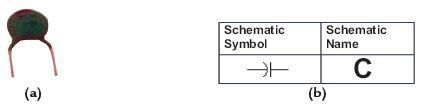
FIGURE 3.7 (a) A ceramic capacitor and (b) its schematic symbol and
name.
| ■ | A ceramic capacitor is brown and has a disc shape. These capacitors are nonpolarized, meaning that you can connect them in any way. To find the value, you simply decode the 3-digit number on the surface of the capacitor. The coding is just like the resistor color codes except that they used numbers instead of colors. The first 2 digits are the significant figures and the third digit is the multiplier. These capacitors are measured in pF. | |
| ■ | Electrolytic capacitors have a cylinder shape. These capacitors are polarized so you must connect the negative side in the right place. The value of the resistor as well as the negative side is clearly printed on the capacitor. These capacitors are measured in F. |
© 2006-2026 Infinity Science Press. All rights reserved.