 | This up-to-date text/reference is designed to present the fundamental principles of robotics with a strong emphasis on engineering applications and industrial solutions based on robotic technology. It can be used by practicing engineers and scientists - or as a text in standard university courses in robotics. The book has extensive coverage of the major robotic classifications, including Wheeled Mobile Robots, Legged Robots, and the Robotic Manipulator. A central theme is the importance of kinematics to robotic principles. The book is accompanied by a CD-ROM with MATLAB simulations, photographs, tutorials, and third-party software (see About the CD-ROM section). |
 TABLE OF CONTENTS
 Robotics
3.8.1 DC Motors
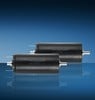
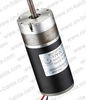
DC motors are widely used in robotics because of their small size and high energy output. They are excellent for powering the drive wheels of a mobile robot as well as powering other mechanical assemblies.
Ratings and Specifications
Several characteristics are important in selecting a DC motor. The first two are its input ratings that specify the electrical characteristics of the motor.
Operating Voltage
If batteries are the source of power for the motor, low operating voltages are desirable because fewer cells are needed to obtain the specified voltage. However, the electronics to drive motors are typically more efficient at higher voltages. Typical DC motors may operate on as few as 1.5 volts or up to 100 volts or more. Roboticists often use motors that operate on 6, 12, or 24 volts because most robots are battery powered, and batteries are typically available with these values.
Operating Current
The ideal motor would produce a great deal of power while requiring a minimum of current. However, the current rating (in conjunction with the voltage rating) is usually a good indication of the power output capacity of a motor. The power input (current times voltage) is a good indicator of the mechanical power output. Also, a given motor draws more current as it delivers more output torque. Thus, current ratings are often given when the motor is stalled. At this point it is drawing the maximum amount of current and applying maximum torque. A low-voltage (e.g., 12 volts or less) DC motor may draw from 100 mA to several amperes at stall, depending on its design.
The next three ratings describe the motor s output characteristics.
Speed
Usually, this is specified as the speed in rotations per minute (RPM) of the motor when it is unloaded, or running freely, at its specified operating voltage. Typical DC motors run at speeds from one to twenty thousand RPM. Motor speed can be measured easily by mounting a disk or LEGO pulley wheel with one hole on the motor, and using a slotted optical switch and oscilloscope to measure the time between the switch openings.
Torque
The torque of a motor is the rotary force produced on its output shaft. When a motor is stalled it is producing the maximum amount of torque that it can produce. Hence the torque rating is usually taken when the motor has stalled and is called the stall torque. The motor torque is measured in ounces-inches (in the English system) or Newton-meters (metric). The torque of small electric motors is often given in milli-Newton-meters (mN-m) or 1/1000 of a N-m. A rating of one ounce-inch means that the motor is exerting a tangential force of one ounce at a radius of one inch from the center of its shaft. Torque ratings may vary from less than one ounce-inch to several dozen ounce-inches for large motors.
Power
The power of a motor is the product of its speed and torque. The power output is greatest at about halfway between the unloaded speed (maximum speed, no torque) and the stalled state (maximum torque, no speed). The output power in watts is about (torque) x (rpm) / 9.57.
© 2006-2026 Infinity Science Press. All rights reserved.