 Intended as a textbook for electronic circuit analysis or a reference for practicing engineers, the book uses a self-study format with hundreds of worked examples to master difficult mathematic topics and circuit design issues. Computer programs using PSpice and MATLAB on the accompanying CD-ROM provide calculations and executables for visualizing and solving applications from industry. It covers the complex mathematical topics and concepts needed to understand and solve serious circuits problems.
 TABLE OF CONTENTS
 Network Analysis and Circuits
Chapter 12.6 - Selectivity And Bandwidth
12.6 SELECTIVITY AND BANDWIDTH
A series RLC circuit gives an unequal response to voltages of different frequencies.
At the frequency of resonance the impedance is minimum and the
current is maximum. As the frequency of the applied voltage is either reduced
or increased from this resonance frequency, the impedance increases and
the current falls. Figure 12.9 shows the variation of current I with frequency.
Thus, a series RLC circuit possesses frequency selectivity.
Figure 12.9 shows current versus frequency curves of a series RLC circuit
for a small value of R. The frequencies f1 and f2 at which current I falls to 
(or 0.707) of its maximum value  are called half-power frequencies.
The bandwidth (f2 − f1) is called the half-power bandwidth or simply the
bandwidth of the circuit.
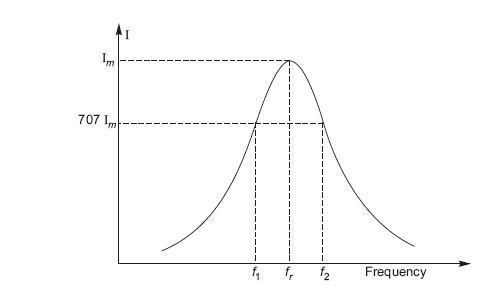
FIGURE 12.9 Current versus frequency curve of a series RLCcircuit.
Selectivity of a resonant circuit is defined as the ratio of resonant
frequency fr to the half power bandwidth, thus selectivity.

The current in the series RLC circuit is given by,

Let ω2 be such a frequency that

Then at frequency ω2,

Magnitude,

Thus, ω2 radians/sec. (or f2 Hertz) gives the upper half-power frequency.
Similarly, let ω1 be such a frequency that,

Then the current at frequency ω1 is given by,

Magnitude,

Thus, ω1 radians/sec. (or f1 Hertz) forms the lower half-power frequency.
Frequencies f1 and f2 are also called half-power frequencies because
the power dissipation in the circuit at these frequencies is half of the power
dissipation at the resonant frequency fr . This may be seen as below:

© 2026 Infinity Science Press