 Intended as a textbook for electronic circuit analysis or a reference for practicing engineers, the book uses a self-study format with hundreds of worked examples to master difficult mathematic topics and circuit design issues. Computer programs using PSpice and MATLAB on the accompanying CD-ROM provide calculations and executables for visualizing and solving applications from industry. It covers the complex mathematical topics and concepts needed to understand and solve serious circuits problems.
 TABLE OF CONTENTS
 Network Analysis and Circuits
Chapter 12.2 - Series Resonance
12.2 SERIES RESONANCE
Figure 12.1 shows a series RLC circuit. A sinusoidal voltage V sends a current
I through the circuit. The circuit is said to be resonant when the resultant reactance
is zero, (i.e., the circuit is purely resistive or we can say the imaginary
part should be equal to zero).
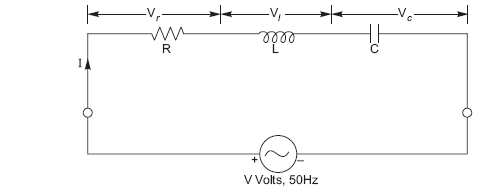
FIGURE 12.1 Series RLC circuit connected to a voltage source V.
The impedance Z of the circuit is given by

where
Z and R in ohms
L is in Henrys
C is in Farads
and ω is the angular frequency of the applied voltage in radians/sec.
The current,
At resonance, the imaginary part of Z should be equal to zero

where ω0 is the frequency of resonance in radians/seconds or the resonant
frequency. From Equation (12.3), we get

or

where fr is the frequency of resonance in Hertz.
At resonance, putting

The condition is called series resonance.
Series resonance at any desired frequency f may be obtained by varying
either L or C or both. For fixed values of L and C series resonance may be
achieved by varying the frequency of the applied signal. This type of circuit
is known as an acceptor circuit because the value of the current at resonance
is maximum.
Example 12.1. A series RLC circuit consists of a resistance 100Ω, an inductance
of 0.1 Henry, and a capacitance of 0.01μF. Calculate the frequency of
resonance in Hertz and in radians/seconds.
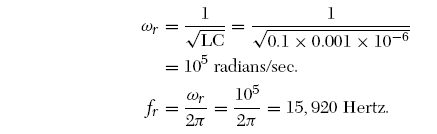
Solution: The frequency of resonance is
Example 12.2. Two impedances Z1 = a + jb and Z2 = c − jd are connected
in series. Find the condition for resonance.
Solution: Two impedances are connected in series

At resonance the circuit will be purely resistive, therefore, the imaginary
part of Zeq should be equal to zero,

This is the condition for resonance.
Example 12.3. Find XL for the condition of resonance in the given circuit:
Solution:

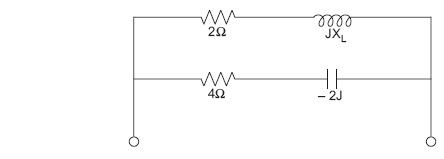
FIGURE 12.2
Z1 and Z2 are connected in parallel
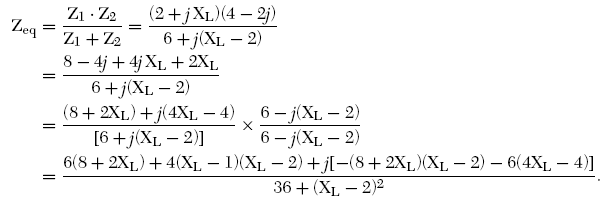
Now the imaginary part of Zeq should be equal to zero at resonance.

or
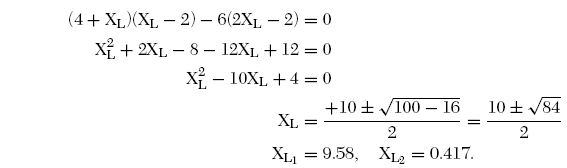
There are two values for XL.
Example 12.4. Find the condition for resonance in the given circuit:
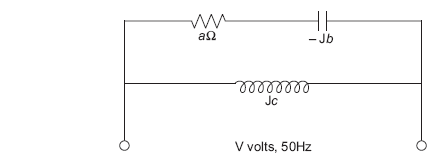
FIGURE 12.3
Solution:
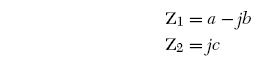
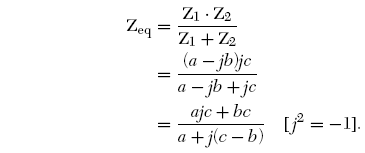
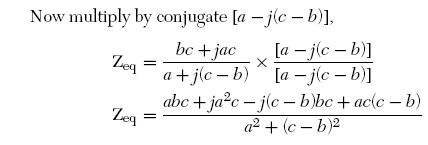
or

The imaginary part should be equal to zero,
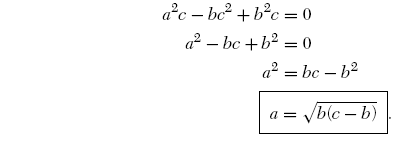
This is the condition for resonance.
Example 12.5. A series RLC circuit resonates at 104Hz. The value of
inductance is 0.02 Henry. Calculate the value of the capacitances.
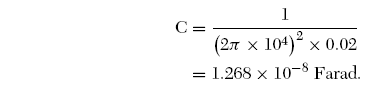
Solution: Let the capacitance be C Farads.
Then

Hence,
© 2026 Infinity Science Press