 Intended as a textbook for electronic circuit analysis or a reference for practicing engineers, the book uses a self-study format with hundreds of worked examples to master difficult mathematic topics and circuit design issues. Computer programs using PSpice and MATLAB on the accompanying CD-ROM provide calculations and executables for visualizing and solving applications from industry. It covers the complex mathematical topics and concepts needed to understand and solve serious circuits problems.
 TABLE OF CONTENTS
 Network Analysis and Circuits
Chapter 1 - Introduction
1.1 WHAT IS A NETWORK?
In general terms, a network is a combination of elements. The interconnection of two or more simple elements (active and passive) is called an electrical network.
1.1.1 Active Elements
Elements, which can generate energy, are known as active elements (e.g., battery, generator).
1.1.2 Passive Elements
Elements, which cannot generate energy but can dissipate or store energy are known as passive elements (e.g., resistor, inductor, capacitor).
A network, which contains at least one active element, is known as an active network. A network, which does not contain any active elements, is a passive network.
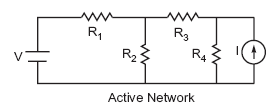
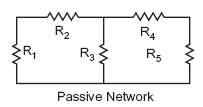
FIGURE 1.1 FIGURE 1.2
If a network contains at least one energized closed path, it is also an electric circuit. Every circuit is a network but not all networks are circuits (e.g., T-networks).
© 2026 Infinity Science Press