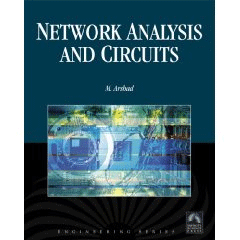
 Intended as a textbook for electronic circuit analysis or a reference for practicing engineers, the book uses a self-study format with hundreds of worked examples to master difficult mathematic topics and circuit design issues. Computer programs using PSpice and MATLAB on the accompanying CD-ROM provide calculations and executables for visualizing and solving applications from industry. It covers the complex mathematical topics and concepts needed to understand and solve serious circuits problems.
 TABLE OF CONTENTS
 Network Analysis and Circuits
Chapter 11 - Network Synthesis
11.1 INTRODUCTION
The network, the excitation, and the response. If any two of the three quantities
are given, the third may be found for linear networks. If the network and
the excitation are given and the response is to be determined, the problem is
defined as analysis. When the excitation and the response are given, and it is
required to determine a network, the problem is defined as synthesis. If the
network and the response are given to find the excitation there is generally
no accepted name and it is not common.
Synthesis is the process of finding a network corresponding to a given
driving-point impedance or admittance. In this chapter, we will consider
some aspects of passive network synthesis, mainly driving-point immittance
functions (impedance or admittance functions),

where F(s) is the network function, which is the ratio of response R(s) to the
excitation E(s).
© 2026 Infinity Science Press