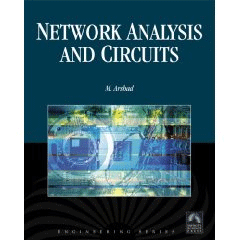
 Intended as a textbook for electronic circuit analysis or a reference for practicing engineers, the book uses a self-study format with hundreds of worked examples to master difficult mathematic topics and circuit design issues. Computer programs using PSpice and MATLAB on the accompanying CD-ROM provide calculations and executables for visualizing and solving applications from industry. It covers the complex mathematical topics and concepts needed to understand and solve serious circuits problems.
 TABLE OF CONTENTS
 Network Analysis and Circuits
Chapter 12.12 - Impedance Of Parallel-Tuned Circuit
12.12 IMPEDANCE OF PARALLEL-TUNED CIRCUIT
(a) At resonance. From Equation (12.54), the admittance of the paralleltuned
circuit at resonance is given by

But from Equation (12.59), 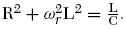
Hence,

Hence, impedance at resonance is given by

This is a pure resistance and is often called the dynamic resistance of the
parallel-tuned circuit.
From Equation (12.65) we see that the lower the resistance R of the coil,
the higher the value of the resistance Ra at resonance. Therefore, current
flowing through the circuit is very small, hence, parallel resonance circuits
are known as rejector circuits.
The current down from the supply source at resonance is called the make
up current and is equal to  . The current in the capacitor branch or
inductor branch is called the forced oscillatory current and is equal to VωrC.
Hence,
Thus, the parallel-tuned circuit at resonance exhibits current magnification
of  while the series resonant circuit exhibits voltage
magnification of the same value Qr.
The dynamic resistance Ra of the parallel-tuned circuit may also be
expressed in terms of Qr. Thus,

Also,

(b) Impedance at a frequency close to resonant frequency. The
impedance of the parallel-tuned circuit of Figure 12.17 at any frequency ω is
given by
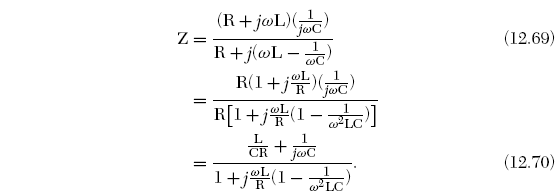
Equation (12.70) gives the general expression for impedance of a parallel
circuit at any frequency ω. In most cases, however, we are concerned with
frequencies close to the resonant frequency of the parallel-tuned circuit. For
such frequencies, let δ give the fractional frequency deviation or the fractional
detuning defined as below

Then

Hence,

For Qr > 10,

Hence,

Hence, Equation (12.70) yields
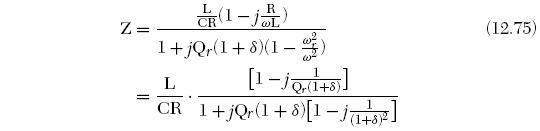
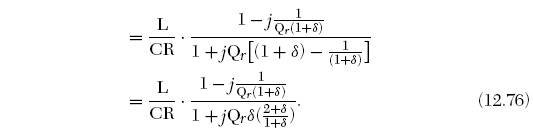
At parallel resonance, ω = ωr and δ = 0.
Hence, at resonance, the impedance of the parallel circuit is

For Qr > 10,  is small in comparison with unity and may, therefore,
be neglected.
Hence,

This impedance at resonance is a pure resistance and may be denoted Rt.
Equation (12.76) gives the impedance of the parallel circuit for any value
of δ. However, if the signal frequency is close to resonance, i.e.,δ < 1, then
neglecting δ in comparison with unity, Equation (12.76) may be written as

Further, if Qr > 10, < 1, Then Equation (12.79) reduces to

or

Figure 12.18 gives the nature of variation of relative impedance  of
of
the parallel-tuned circuit with frequency f. The impedance is maximum
at resonance and falls off suply for frequencies either below or above this.
The frequencies f1 and f2 at which the impedance falls to (or 0.707 Rt)
constitute the half-power frequencies.
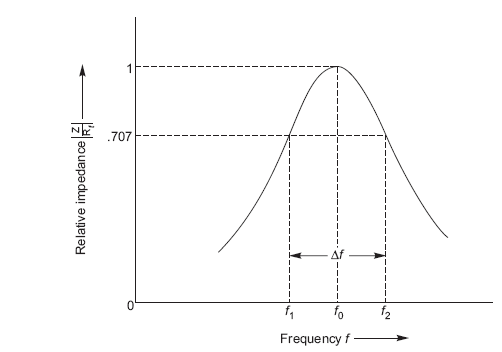
FIGURE 12.18 Variation of relative impedance of a parallel-tuned circuit with frequency.
© 2026 Infinity Science Press