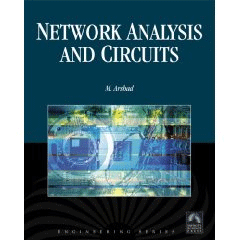
 Intended as a textbook for electronic circuit analysis or a reference for practicing engineers, the book uses a self-study format with hundreds of worked examples to master difficult mathematic topics and circuit design issues. Computer programs using PSpice and MATLAB on the accompanying CD-ROM provide calculations and executables for visualizing and solving applications from industry. It covers the complex mathematical topics and concepts needed to understand and solve serious circuits problems.
 TABLE OF CONTENTS
 Network Analysis and Circuits
Chapter 8 - Network Theorems
8.1 INTRODUCTION TO NETWORK THEOREMS
Anyone who has studied geometry should be familiar with the concept of a
theorem: a relatively simple rule used to solve a problem, derived from a more
intensive analysis using fundamental rules of mathematics. At least hypothetically,
any problem in mathematics can be solved just by using the simple rules
of arithmetic (in fact, this is how modern digital computers carry out the most
complex mathematical calculations: by repeating many cycles of addition and
subtraction!), but human beings aren’t as consistent or as fast as a digital
computer. We need “shortcut” methods in order to avoid procedural errors.
In electric network analysis, the fundamental rules are Ohm’s Law and
Kirchhoff ’s Laws. While these humble laws may be applied to analyze just
about any circuit configuration (even if we have to resort to complex algebra
to handle multiple unknowns), there are some “shortcut” methods of analysis
to make the mathematics easier for the average human.
As with any theorem of geometry or algebra, these network theorems are
derived from fundamental rules. In this chapter, we are not going to delve into
the formal proofs of any of these theorems. If you doubt their validity, you can
always empirically test them by setting up example circuits and calculating
values using the “old” (simultaneous equation) methods versus the “new”
theorems, to see if the answers coincide. They always should!
Anyone who has studied geometry should be familiar with the concept of a
theorem: a relatively simple rule used to solve a problem, derived from a more
intensive analysis using fundamental rules of mathematics. At least hypothetically,
any problem in mathematics can be solved just by using the simple rules
of arithmetic (in fact, this is how modern digital computers carry out the most
complex mathematical calculations: by repeating many cycles of addition and
subtraction!), but human beings aren’t as consistent or as fast as a digital
computer. We need “shortcut” methods in order to avoid procedural errors.
In electric network analysis, the fundamental rules are Ohm’s Law and
Kirchhoff ’s Laws. While these humble laws may be applied to analyze just
about any circuit configuration (even if we have to resort to complex algebra
to handle multiple unknowns), there are some “shortcut” methods of analysis
to make the mathematics easier for the average human.
As with any theorem of geometry or algebra, these network theorems are
derived from fundamental rules. In this chapter, we are not going to delve into
the formal proofs of any of these theorems. If you doubt their validity, you can
always empirically test them by setting up example circuits and calculating
values using the “old” (simultaneous equation) methods versus the “new”
theorems, to see if the answers coincide. They always should!
© 2026 Infinity Science Press