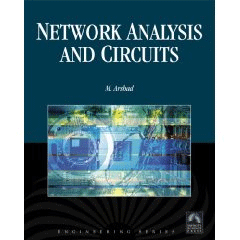
 Intended as a textbook for electronic circuit analysis or a reference for practicing engineers, the book uses a self-study format with hundreds of worked examples to master difficult mathematic topics and circuit design issues. Computer programs using PSpice and MATLAB on the accompanying CD-ROM provide calculations and executables for visualizing and solving applications from industry. It covers the complex mathematical topics and concepts needed to understand and solve serious circuits problems.
 TABLE OF CONTENTS
 Network Analysis and Circuits
Chapter 4 - The Laplace Transform
4.1 INTRODUCTION
The Laplace Transform is a mathematical tool by which time domain is
transformed into frequency domain or frequency domain to time domain.
In order to transform a given function of time f (t) into its corresponding
Laplace transform first multiply f (t) by e−st, where s is a complex number
(s = σ + Jω). Integrate this product with respect to time with a limit from
zero to infinity. This integration results in a Laplace transform of f (t) and this
is denoted F(s) or Lf (t).
s is a complex frequency (σ + Jω).
σ is known as a Neper frequency and ω is known as a real or natural frequency.

The term “Laplace transform of f (t)” is used for the letter Lf (t).
Similarly,
The term “L−1” is called the inverse Laplace transformation.
The time function f (t) and its Laplace transform F(s) are a transform pair.
© 2026 Infinity Science Press