 Intended as a textbook for electronic circuit analysis or a reference for practicing engineers, the book uses a self-study format with hundreds of worked examples to master difficult mathematic topics and circuit design issues. Computer programs using PSpice and MATLAB on the accompanying CD-ROM provide calculations and executables for visualizing and solving applications from industry. It covers the complex mathematical topics and concepts needed to understand and solve serious circuits problems.
 TABLE OF CONTENTS
 Network Analysis and Circuits
Chapter 12.11 - Parallel Resonance
12.11 PARALLEL RESONANCE
A parallel resonant circuit consists of an inductor L in parallel with a capacitor
C as shown in Figure 12.17. R is a small resistance associated with the coil.
The capacitor C is assumed to be lossless. The tuned circuit is driven by a
voltage source V. Such a parallel-tuned circuit is commonly used in tuned
amplifiers, oscillators, etc.
Analysis of a parallel-tuned circuit may be done more conveniently
in terms of admittances instead of impedances. Thus, admittance of the
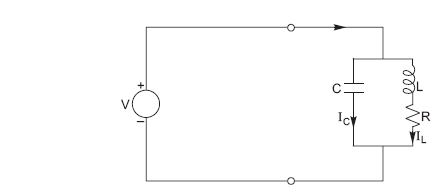
FIGURE 12.17 Parallel resonant circuit.
inductive branch is given by

Admittance of capacitor C is given by

Total admittance

At resonance, the imaginary part should be equal to zero,

or

Hence,

or

If coil resistance (R) is very small (R  0),
0), then fr =
Equation (12.57) may also be put as

Considering the three elements, L, C, and R in series, the Qr is given by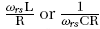 , where ωrs is the series resonant frequency in radians/sec.
Then

Substituting Qrs for  , Equation (12.59) yields

But the frequency of series resonance is given by

Hence,

From Equation (12.62) we find that the frequency of parallel resonance
fr differs from the frequency of series resonance frs. However, if Qrs exceeds
10, then the factor 
© 2026 Infinity Science Press