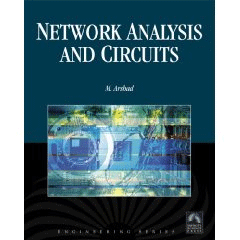
 Intended as a textbook for electronic circuit analysis or a reference for practicing engineers, the book uses a self-study format with hundreds of worked examples to master difficult mathematic topics and circuit design issues. Computer programs using PSpice and MATLAB on the accompanying CD-ROM provide calculations and executables for visualizing and solving applications from industry. It covers the complex mathematical topics and concepts needed to understand and solve serious circuits problems.
 TABLE OF CONTENTS
 Network Analysis and Circuits
Chapter 9 - Network Functions; Poles And Zeros
9.1 INTRODUCTION
In this chapter we introduce the concept of transfer functions relating currents
and voltages in different sections of a network. These functions are
mathematically similar to the transform impedance or admittance functions
and are included in the broader category of functions called network
functions.
Terminal Pairs or Ports. Any network may be represented schematically
by a rectangle or box as shown in Figure 9.1. A network may be used for
a variety of purposes. Thus consider its use as a load connected to some other
network. In order to connect it to the active network, there must be available
two terminals of this passive network. Figure 9.1 shows a network with one
pair of terminals 1-1' or with one port. Such a network may be called a one-port
network or one terminal-pair network. When such a one-port network
is connected to an energy source or an active network at its pair of terminals,
the energy source provides the driving force for this one-port network and
the pair of terminals constitute the driving-point of the network. One pair of
terminals is known as a port.
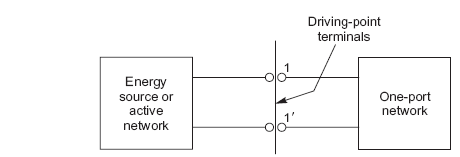
FIGURE 9.1 One-port network driven by a source.
Figure 9.2 shows a two-port network or two terminal-pair network. In this
case, port 1 is connected to the driving force or the input and is called the input
port or the driving port. On the other hand, port 2 (i.e., terminal-pair 2-2'),
is connected to the load and is called the output port or the load port.
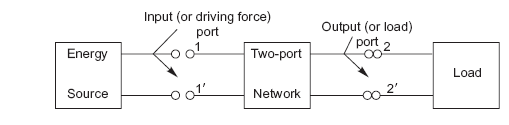
FIGURE 9.2 Two-port network driven by an energy source.
Figure 9.3 shows a general n-port network. Here the driving force
(energy source) may be connected to one or more ports and other networks
may be connected at the remaining ports.

FIGURE 9.3 General n-port network.
© 2026 Infinity Science Press