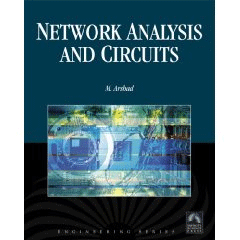
 Intended as a textbook for electronic circuit analysis or a reference for practicing engineers, the book uses a self-study format with hundreds of worked examples to master difficult mathematic topics and circuit design issues. Computer programs using PSpice and MATLAB on the accompanying CD-ROM provide calculations and executables for visualizing and solving applications from industry. It covers the complex mathematical topics and concepts needed to understand and solve serious circuits problems.
 TABLE OF CONTENTS
 Network Analysis and Circuits
Chapter 6 - Circuit Analysis By The Classical Method
6.1 INTRODUCTION
Suppose a system is present. Whether it is working or not does not matter. If
we want to change the present condition of the system; we will apply some
force or signal to the system or remove it from the system. Now the system
is, unbalanced and trying to create a stable or steady state condition from the
start to before achieving the steady-state period is known as the transition
period. During this period the elements, current, and voltages change from
their former values to new ones. This period is known as transient. After the
transition period, the circuit is said to be in a steady state.
Now, the linear differential equation, that is, the drive from the circuit,
will have two components in its solution:
- The complementary function (corresponds to the transient).
- The particular integral (corresponds to the steady state).
Basically, the classical method is a mathematical approach to solve a circuit.
The circuit changes (ON or OFF) are assumed to occur at time t = 0
and are represented by a switch as shown in Figure 6.1.
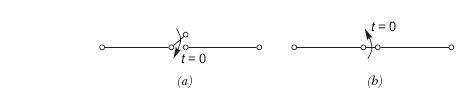
FIGURE 6.1
The arrowhead shows the change in direction. In Figure 6.1(a) initially
the circuit was open, at t = 0 the circuit closed. Similarly, in Figure 6.1(b)
initially fine circuit was closed, at t = 0 the circuit opened.
t = 0−, the instant prior to t = 0
t = 0+, the instant immediately after switching

FIGURE 6.2
Suppose, iL(0 − ) is the value of the current flowing through the inductor
before switching.
Example 6.1. Find the differential equations for the given electrical system.
Solution: Applying KVL,
V = VR + VC.
Put the value of VR and VC using Table 6.1.

Now differentiating the Equation (6.1),


FIGURE 6.3
Example 6.2. Find the differential equation for the given electrical system.
Solution: Applying KVL,

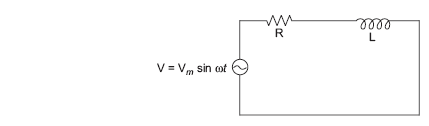
FIGURE 6.4
© 2026 Infinity Science Press